
Carlos Alcaraz didn’t just win the 2025 French Open.
He conquered a narrative.
A storm.
An entire season that threatened to derail not only his form—but his belief.
This wasn’t just another Grand Slam win. It was a statement. A reclamation. A story about pressure, expectations, and the raw emotional cost of greatness.
Let’s dive into the story behind Carlos Alcaraz’s 2025 French Open triumph—the rivalries, the controversy, the nerves, and the redemption.
The 2025 Season: A Cloud of Doubt
Coming into Roland Garros, the tennis world had one name on its lips: Jannik Sinner.
The Italian sensation had climbed to World No. 1 and taken the tennis world by storm after winning the Australian Open and Miami. Meanwhile, Carlos Alcaraz, once hailed as the “next big thing,” was beginning to feel like the “forgotten prince.”
He had battled injuries during the early part of the season and lost key matches against both Sinner and Alexander Zverev. Pundits began asking uncomfortable questions:
“Has Sinner passed him mentally?”
“Is Alcaraz struggling to find his place in this new ATP landscape?”
Alcaraz, ever the professional, didn’t lash out. But the fire inside him began to boil. The French Open, historically one of his favorite Slams, offered the perfect stage for revenge—not just against rivals, but against doubt.
Roland Garros 2025: The Path of Resistance
Alcaraz’s draw was brutal.
From the early rounds, he was tested. Not necessarily by big names—but by clay-court grinders who forced him into long, mentally draining matches.
Unlike in 2023, where he cruised early and then cramped in the semis, this time, Alcaraz took a slower, more tactical route.
He wasn’t playing just to win.
He was playing to outlast the field.
By the time he reached the quarterfinals, fans saw a more composed, mature version of Alcaraz. The forehands were still blistering. The drop shots still cheeky. But the youthful chaos was gone—replaced by measured aggression.
The Semifinal: The Rivalry With Jannik Sinner Reignites
The semifinal was always going to be the real final.
Alcaraz vs. Sinner.
Tennis purists had been waiting for this clash—not just because of the quality, but because of the subtext.
Sinner had dominated their head-to-head in the lead-up to Paris. He had climbed the rankings faster. He had more titles in 2025.
Alcaraz, for the first time in his career, wasn’t the favorite.
What followed was an instant classic. Five sets. Momentum swings. Emotional roars. And most of all, psychological warfare.
At one point, after missing a key break point, Sinner shouted in frustration, “He’s lucky today!”
Alcaraz didn’t respond verbally—but on the next point, he hit an audacious inside-out forehand winner that clipped the line.
He turned to his box and nodded—calmly.
It was vintage Carlos. Swagger without the scream.
He would win the match in five brutal sets.
The Final vs. Zverev: Silence the Doubters
Alexander Zverev had quietly moved through the draw with cold precision. After beating Djokovic earlier in the tournament, he seemed poised to finally claim his first Slam.
But Carlos Alcaraz wasn’t going to be denied.
The final was strange—not the rollercoaster some expected, but rather a clinical, almost surgical takedown by Alcaraz.
His drop shots neutralized Zverev’s rhythm. His passing shots stung like darts. And his mental focus? Impeccable.
In just over three hours, Alcaraz closed out the match in four sets, lifted the trophy, and collapsed to the clay—overcome, not with joy, but with relief.
The Press Conference: Calm Outside, Fire Within
In the post-final press conference, Alcaraz appeared calm. Respectful. Thankful.
But when asked about his critics, his tone sharpened:
“They say I’m not consistent. That I can’t match the others mentally. But I just keep working. I let my racket talk.”
He also made headlines when asked about the late-night scheduling controversy:
“We’ve had some late matches again this year. It’s tough, not just physically but mentally. I think players should have more say in that.”
It wasn’t a scream or a rant. But it was rare for Alcaraz to push back publicly. And it was clear he had more to say—if only indirectly.
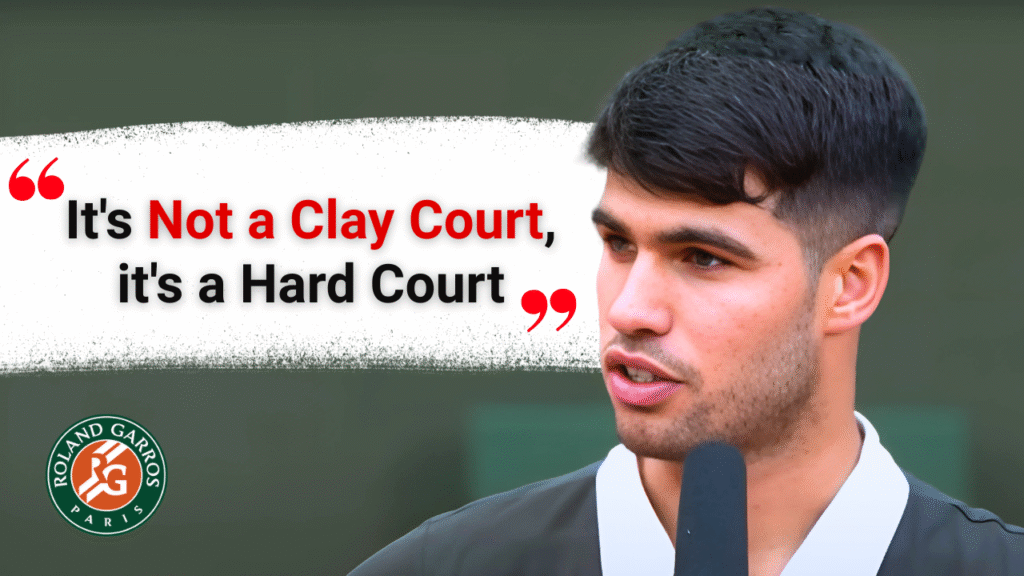
The Court Conditions Controversy
Throughout the tournament, players complained about the condition of Court Suzanne-Lenglen, with many saying it was too slippery and uneven.
When asked about it, Alcaraz didn’t dodge:
“I noticed the same. I slipped a few times. We adapt, but it’s something that needs attention.”
His honesty drew both praise and criticism. Some said it showed leadership. Others accused him of making excuses for a few unforced errors earlier in the tournament.
Regardless, Alcaraz had taken a stand—something he had rarely done before.
This was a new chapter in his career: Carlos the Competitor, Carlos the Leader.
A Rivalry That’s Just Getting Started
While Alcaraz lifted the trophy, many tennis fans couldn’t help but think about Sinner.
The semifinal had been razor-tight. It could’ve gone either way.
Their head-to-head now sits almost dead even, and tennis is finally getting what it has been waiting for: a modern-day Federer vs. Nadal-type rivalry, forged not just in contrast of styles but contrast of temperament.
Sinner: methodical, controlled, ice-cold.
Alcaraz: electric, instinctive, passionate.
And with Djokovic aging, this rivalry may define the next decade.
What This Win Really Means
Yes, it’s his third Slam.
Yes, he’s now back in the Top 2.
But this win means more because it was earned under pressure—media pressure, injury pressure, and personal pressure.
2025 could have been the year Alcaraz slipped into irrelevance as Sinner dominated headlines.
Instead, he reminded the world:
“I’m still here. And I’m not done.”
Final Thoughts: A New Carlos Emerges
The 2025 French Open didn’t just give us a champion.
It gave us a man who’s growing up in front of our eyes.
He’s no longer the teenage phenom.
He’s not just the smiling Spaniard with drop shots and speed.
He’s a warrior, a leader, and perhaps—by the time the year ends—the World No. 1 again.
Carlos Alcaraz’s 2025 French Open is a turning point in his career.
Not because he won, but because of how he did it—and who he became doing it.
And if this is the new normal, tennis fans are in for a golden era.
Share this content:


